

Releases
March 18, 2026
·
3
min read

Teaching 3D CAD to AI - Context-Selective 3D Data Access

The value of AI in engineering is no longer in question. The focus has shifted from proving that AI works to figuring out how it can deliver real, domain-specific impact. Nowhere is this more urgent than in mechanical engineering. Companies sit on decades of 3D CAD data - parts, assemblies, PMI, Metadata - scattered across PDMs, PLMs, file shares, and proprietary formats. These models capture deep, structured knowledge about how things are designed, built, and function. How can engineering companies use this data to train AI to truly understand the complex world of mechanical design? That’s the question we’re beginning to answer.

Bridging the Gap: The Challenge of Providing AI Models with the 3D Data

Concrete AI use cases are now emerging where companies train their own models tailored to domain-specific engineering challenges. Mechanical engineering teams are moving beyond pure research into early applications, with growing opportunities to leverage 3D CAD data for specialized training. To make these models effective, however, reliable access to high-quality 3D data is crucial — the better the training data, the better the model. At the same time, 3D data remains difficult to access on a larger scale.

Introducing "Context-Selective 3D Data Access for AI Model Training”
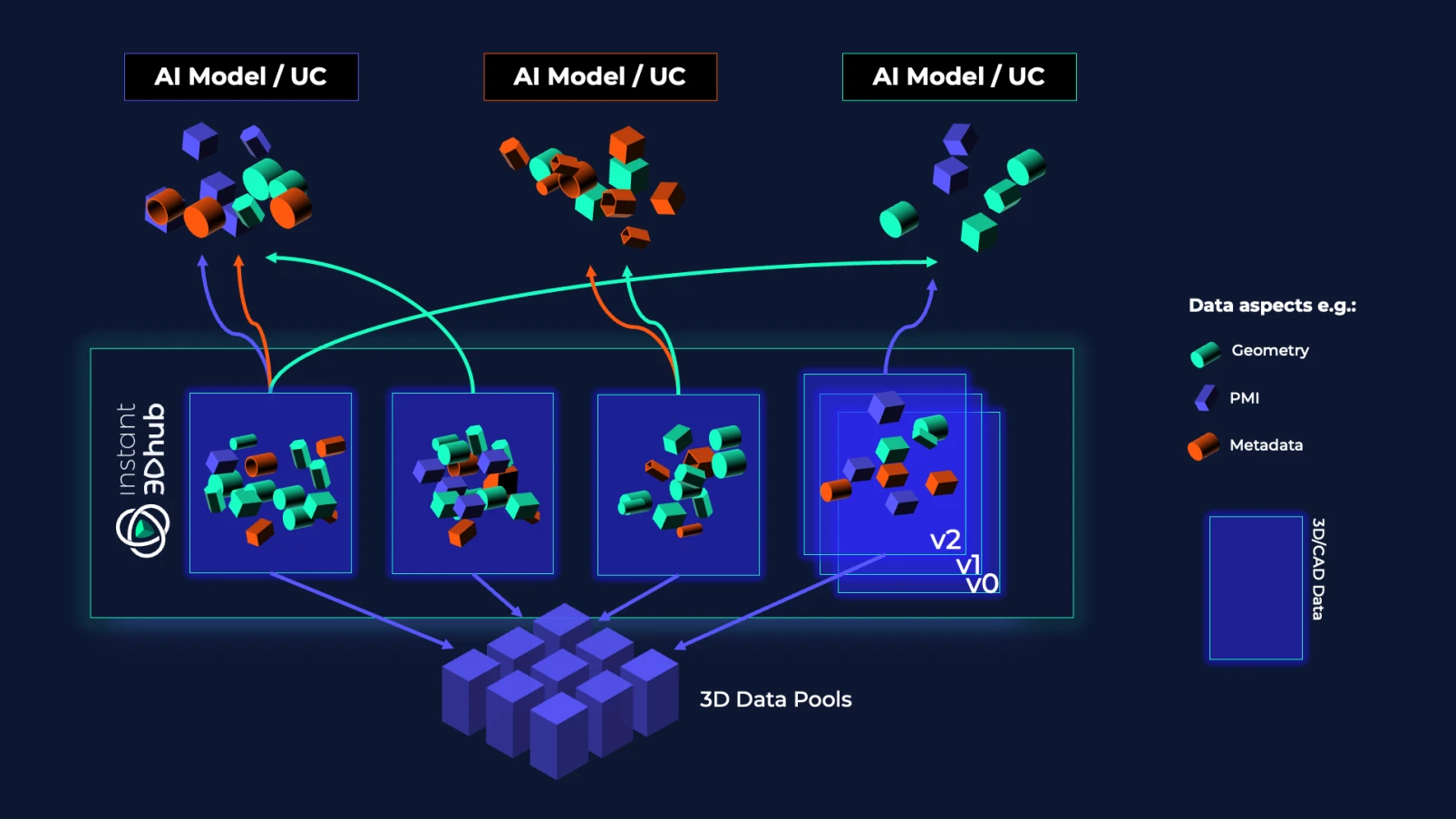
Content-Selective 3D Data Access with instant3Dhub

We’re exploring an approach we call Context-Selective 3D Data Access for AI Model Training.

With instant3Dhub, users can curate and provide only the most relevant 3D data elements for each use case, rather than entire data sets. This targeted selection enables more efficient and effective AI training.

Instead of supplying full CAD assemblies—like handing over an entire textbook when only one chapter is needed—we extract and deliver only what’s required, such as:

  • Product structure
  • Geometry definitions
  • Metadata
  • PMI and model views
  • Other context-relevant 3D data entities

This isn’t about reducing data quality; it’s about intentional, context-aware training that drives better results.

Purpose-Built Infrastructure: Making 3D Data Accessible for AI

instant3Dhub is designed to support domain-specific AI training at scale by connecting directly to existing data backends, such as PLM systems, and preparing 3D data for real-time, on-demand streaming through a unique caching mechanism.

All relevant data - structure, geometries, metadata, etc. - is accessible via 3D Spaces: digital work rooms where information is coherently structured and accessible.

Developers and AI engineers interact with these 3D Spaces via APIs, enabling:

  • Intelligent curation: Extract only the contextually relevant 3D data for each training scenario.
  • Precise access: Deliver targeted data slices—product structure, geometry, metadata, PMI, and model views—tailored to the training task.

This architecture ensures that training data remains purposeful, scalable, and preserves essential engineering context.

instant3Dhub as enabler between AI Agents and 3D

For targeted training scenarios, this selective streaming architecture shows early promise:

  • Less noise in AI training data leading to better model results
  • Stronger traceability from source data to AI model outcomes leading to
  • Tighter feedback loops between engineering expertise and model learning leading to faster results and higher quality

Looking ahead, instant3Dhub is set to play a key role connecting AI and 3D engineering data. With structured, real-time access through APIs, instant3Dhub can become the essential infrastructure that makes 3D data truly usable for AI. This idea will be explored more in future articles, but it already guides how we make data accessible and ready for AI agents.

This is Just the Beginning

We are early in our journey. Some features, like on-demand extraction in an AI Training scenario, are possible but still experimental. Moving these into scalable product offerings will need more validation and collaboration. Early use cases however show strong potential for AI integration in engineering.

We are also exploring deep integration with knowledge graphs to improve connections between data entities and unlock richer context for 3D engineering data.

If you’re facing similar challenges with making CAD data usable for AI, write me via LinkedIn or our usual channels.

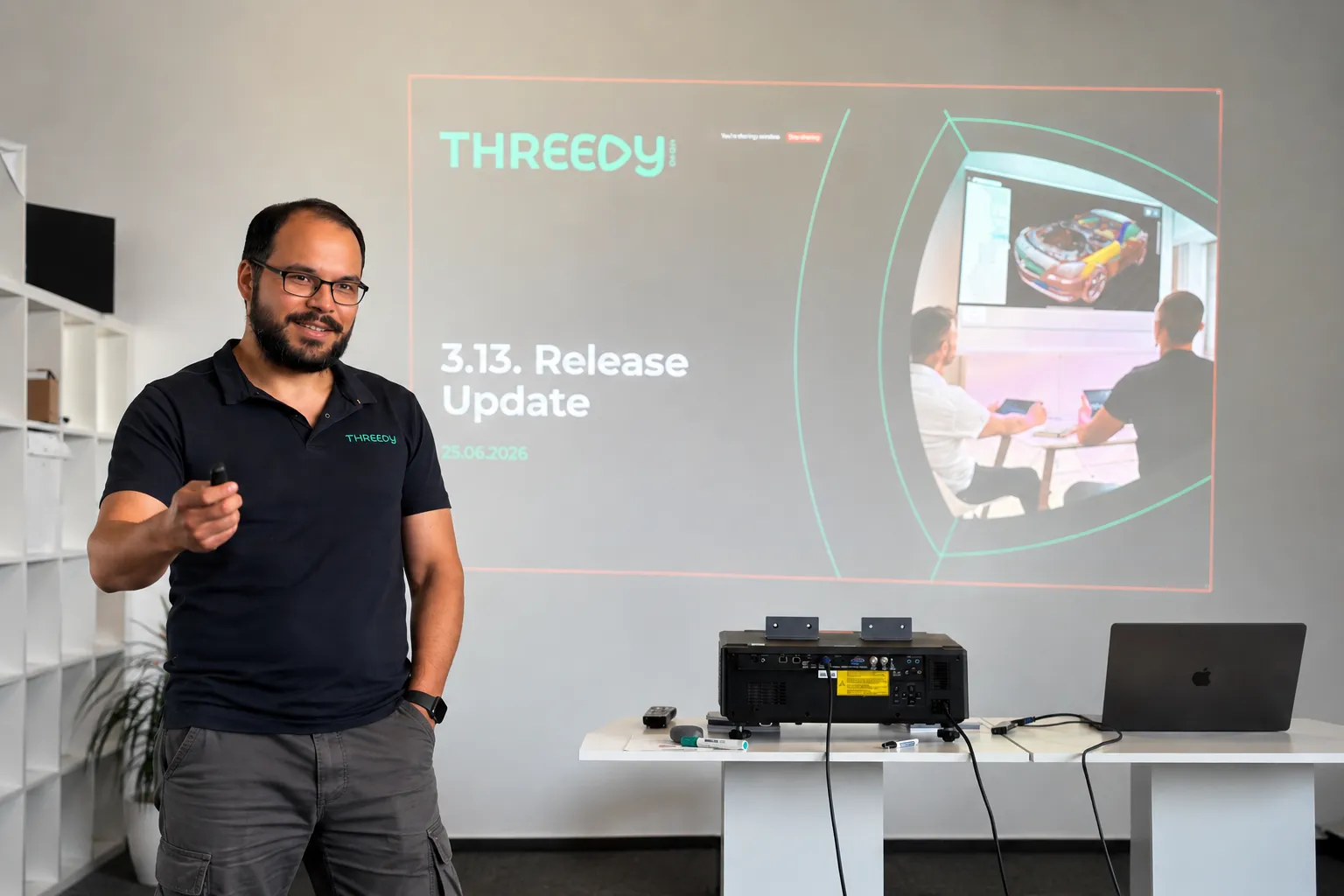
Hannes Krug is a Product Manager at Threedy, working to improve instant3Dhub and Threedy's product offerings. He operates at the intersection of engineering and developer users, with a particular focus on enhancing CAD and 3D data workflows within instant3Dhub.
Share this article:

Read our latest blogs

View all blog
What's New in instant3Dhub 3.13: The AI Edition

Every AI conversation right now eventually lands on the same question: what does this actually change about how people work? For 3D data, 3.13 is our first answer.

The headline feature is the MCP server. It's experimental, it's built into every deployment, and it's the first time an AI assistant can talk directly to a 3DSpace - not to a description of the data, but to the 3D data itself.

Here's what that means in practice, and what else changed in this release.

AI assistants that work with your CAD data

The MCP server ships with every instant3Dhub 3.13 deployment. No separate setup. You connect with an MCP-compatible AI assistant - Claude, Cursor, VS Code Copilot, others - point it at a 3DSpace, and it can start working with your 3D data.

What it can do once connected:

  • Query and navigate the product structure
  • Read and write node properties - visibility, color, metadata
  • Transform nodes: position, rotation, scale
  • Create, update, and remove annotations
  • Define and modify clip planes
  • Take measurements: distances, volumes, surface areas

That means prompts like "find all parts where the material is set to aluminum" or "hide everything except the engine subassembly" work as you'd expect. The assistant isn't approximating based on a text description. It's querying the actual scene.

One thing worth being explicit about: MCP tool results - node names, metadata, measurements, scene structure - are sent to the LLM as part of the conversation. The LLM provider never connects to your network, and 3D mesh geometry is not transmitted. If your models contain classified metadata, check with your security team before connecting an external AI assistant.

We're shipping this as experimental. That means it's ready to build on, but it can change quickly and we want your feedback on it.

In 3.13, we've reworked the Query API to support runtime state and nested logic. This is the infrastructure the MCP server sits on — and it also matters directly for developers building on top of instant3Dhub. Less friction, faster results, fewer edge cases.

The 3DSpace as a more manageable

The 3DSpace is where teams work together on 3D data - synchronously and asynchronously, without passing files. 3.13 makes it easier to link, share, and operate:

  • Custom space IDs - open a space with a user-defined identifier instead of an auto-generated one
  • Define when a 3DSpace gets fully deleted with retention policy via values.yaml
  • Multi-user apps with MemberAPI integrated, legacy XRMembers removed
  • SessionAPI removed - fully migrated to SpaceAPI; if you're on an older integration, now is the time to update

Other things worth knowing about:

Performance: Lower cloud costs and faster performance. GPU memory usage is down and rendering budgets are more predictable, so you get more out of less hardware. The experimental CPU-based culling can take load off the GPU entirely, cutting the need for expensive GPU instances. Large models render faster, and the GUI freezes some of you hit on heavy assemblies are fixed.

Orientation: Easier orientation in complex scenes. The navigation cube is now HTML-based and shows coordinate axes, so it's quicker to stay oriented when you're navigating large, deeply nested assemblies.

Authorization: Less setup in nested structures. Parent-based authorization is now an option alongside authorizing each node individually. Let children inherit authorization from their parent and you skip a separate auth request for every node. Fewer requests and less overhead, especially in deep hierarchies.

Interoperability: More of your Teamcenter data comes through cleanly. Better handling of JT content (including threaded features) plus basic support for PLM XML and JT assemblies exported from Teamcenter.

Usability: Measurement and search, faster to use. Measurement mode is now one click from the toolbar. In double measurement, your first target stays highlighted so you don't lose your place. And the search bar gets select-all and clear, handy when you're working through long result lists.

Operations: Simpler ops and deployment. Helm upgrades now restart affected services automatically, external database setups no longer need Ansible, and serial keys can be managed through Kubernetes secrets. Less manual work to deploy and maintain.

Security: We fixed XSS vulnerabilities in the Print Manager, annotations, and webvisUI notify functions.

July 1, 2026
·
4
min read
Beyond CAD: Where AI for 3D Data Gets Interesting

AI for 3D data is coming to industrial workflows

This is about AI agents that can work with 3D data to handle tasks that humans currently do. Not tools that help you design faster, but agents that take on whole work steps: reviewing, interpreting, communicating, reporting. The same shift we've seen in text-based knowledge work like legal, now entering spatial data.

This matters because 3D data in industrial companies isn't just sitting in CAD tools. It moves. It goes from design to manufacturing. It goes from engineering to sales. It goes from development to the customer and back. At every handoff, someone has to translate that 3D data into something another person or team can act on. That translation work is manual, expert, and time-consuming. That's the target.

June 4, 2026
·
6
min read
Cross-Company 3D Collaboration Gets a Standard

The Catena-X Geometry Kit

The Catena-X Geometry Kit is a standard for cross-company 3D geometry exchange, now part of Tractus-X. It defines how to describe, publish, and consume 3D geometry across company boundaries building on the Catena-X architecture and advantages.

Building on Catena-X, the Geometry Kit enables sharing of 3D geometry data in a dataspace between companies: a setup where multiple organizations share data in a controlled, decentralized, and interoperable way, without giving up ownership of it. The Eclipse Dataspace Connector (EDC) is the standardized interface each participant uses to communicate across that space. Geometry is published with a policy attached, scoped to a specific project and partner, with an expiry date. That policy is enforced technically, not just agreed contractually. And because it's a shared standard, there's no bilateral integration to build per partner and others can join the dataspace with low effort.

How It Works in Practice

A supplier publishes integration-relevant geometry through their Digital Twin Registry. The OEM accesses it through their own application interfaced via the EDC. When there's an update, the partner accesses the new version through the same channel. No stale copies sitting on their side to track down. When the project closes, the supplier revokes the policy and access ends automatically.

Use Case Overview as presented on Prostep IVIP 2026

This also handles heterogeneous PLM and CAD tooling without custom integration per project. Standardized interfaces do that work once, at the infrastructure level. If a third organization needs to join mid-project, they connect to the network without requiring changes from anyone already in it.

One thing worth being upfront about: your tooling vendor needs to implement the EDC interfaces. The standard only works if the tools in the room support it.

Where instant3Dhub Fits

instant3Dhub implements the Geometry Kit on the consumer side. Geometry published via Catena-X streams directly into instant3Dhub for review, clash detection, DMU checks, and collaborative sessions across organizations, without export or conversion.

We demonstrated this end to end at the prostep ivip Symposium with Schaeffler. Try the demo in the browser. If your organization is evaluating adoption, book a call or reach out at product@threedy.io.

Hannes Krug, Senior Product Manager & AI-Lead at Threedy GmbH

April 8, 2026
·
2
min read